
Flat Tire Assistance Austin TX: What to Do, Stay Safe & Get Help
A flat tire can happen anywhere in Austin. Learn how to stay safe, whether you can drive, what to do without a spare, and where to find roadside help.
By Kwik Roadside TeamPublished 13 min read
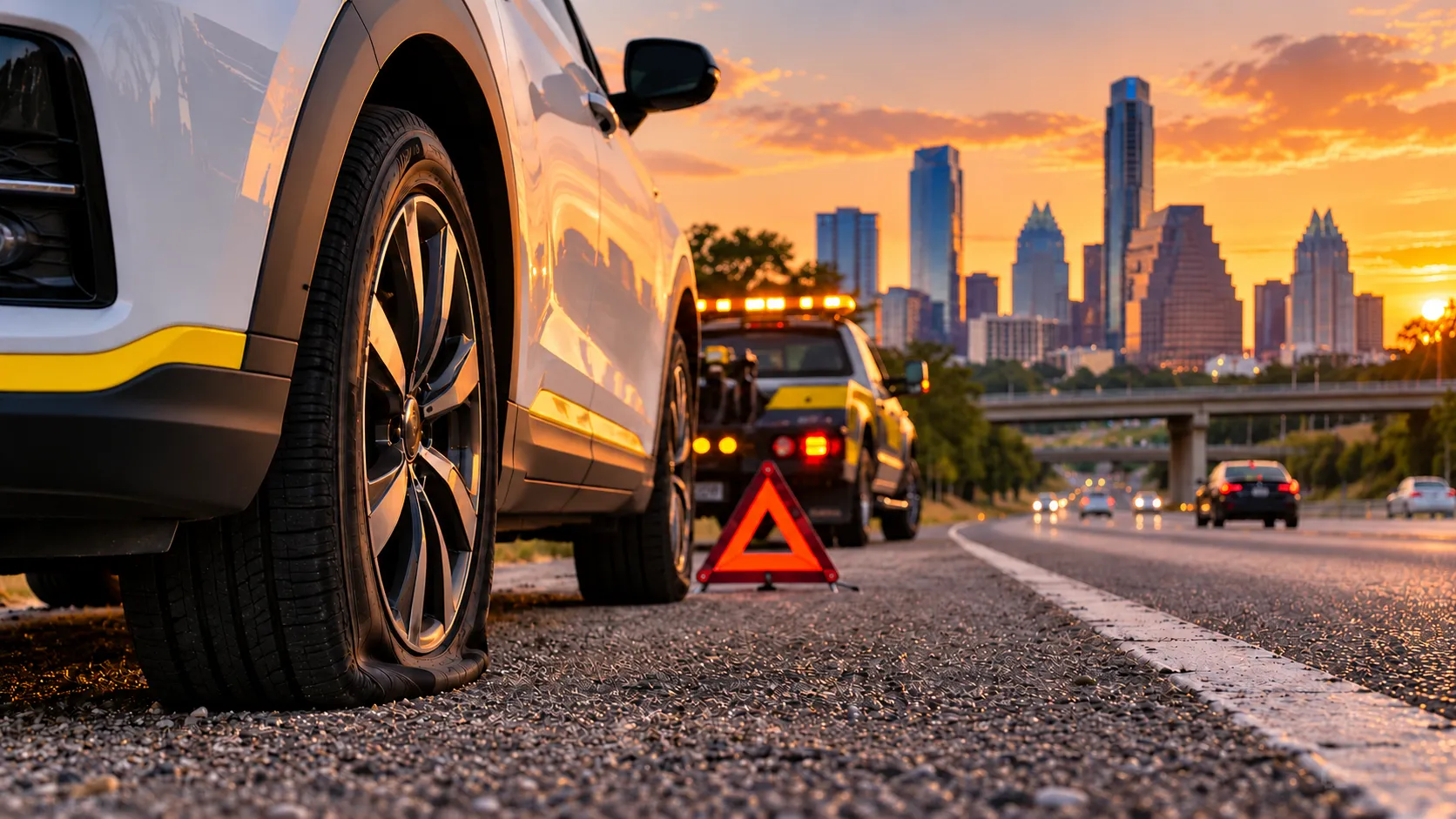
A flat tire can turn an ordinary drive across Austin into a stressful roadside emergency. Maybe you hit something on I-35, noticed your steering wheel pulling on MoPac, or discovered a completely flat tire in a parking lot near The Domain.
Wherever it happens, your first priority isn't changing the tire. It's getting yourself, your passengers, and your vehicle out of danger.
The good news is that not every flat tire requires a tow truck or an expensive repair. In many situations, a roadside technician can install your spare tire where you're parked, allowing you to safely continue to a tire shop.
This guide explains exactly what Austin drivers should do when a tire goes flat, when it's safe to handle the problem yourself, what to do without a spare, and how to find reliable roadside tire change assistance.
Need help with a flat tire right now? Kwik Roadside Assistance Austin offers 24/7 mobile spare tire installation, with a published base service rate of $75.
Call or text (512) 855-3255 to request assistance and confirm your location, price, and estimated arrival time.
1. What to Do Immediately When You Get a Flat Tire
What you do in the first few moments matters, especially if you're driving on one of Austin's busy highways.
A tire may lose air gradually because of a nail or valve problem, or suddenly because of a blowout. In either situation, the goal is to maintain control and stop somewhere safe.
Your immediate flat tire safety checklist
- Keep a firm grip on the steering wheel. If your tire suddenly blows out, avoid jerking the wheel or slamming on the brakes. Gradually ease off the accelerator and maintain control.
- Look for a safe place to stop. A parking lot, low-traffic side street, or designated pull-off is preferable to a narrow highway shoulder, provided you can reach it safely.
- Turn on your hazard lights. Make your vehicle visible to approaching traffic as you slow and once you're stopped.
- Secure your vehicle. Put it in Park, engage the parking brake, and switch off the engine once you've stopped safely.
- Assess the surroundings before getting out. Never step into an active traffic lane to inspect a tire. If you're in an exposed highway location, staying buckled inside may be safer until assistance arrives.
According to the National Highway Traffic Safety Administration (NHTSA), sudden braking or steering during a blowout can make the vehicle harder to control.
If your vehicle is blocking a traffic lane, someone is injured, or you face immediate danger, call 911 rather than attempting to deal with the tire yourself.
2. Flat Tire on I-35, MoPac or US-183? Safety Comes First
Austin drivers face a different set of challenges depending on where their tire goes flat.
A flat in a quiet residential driveway is very different from a blowout beside high-speed traffic on Interstate 35.
Flat tire on I-35
Interstate 35 is one of Austin's main transportation corridors, connecting areas such as Downtown Austin, North Austin, Buda, Kyle, and San Marcos.
If a tire fails on I-35, keep your steering movements smooth and find a safe stopping location as soon as reasonably possible. Don't try to reach a particular exit if doing so would require continued driving on a severely damaged tire or create another danger.
If you end up on a narrow shoulder, avoid attempting to change the tire beside moving traffic. A vehicle jack does not protect you from passing vehicles.
Flat tire on MoPac (Loop 1)
MoPac connects important residential and commercial areas across Austin, including portions of Northwest Austin and the central city.
Some stretches offer limited room to stop safely.
If you're unable to reach a safe parking area, turn on your hazard lights, report your precise location, and request assistance. Don't stand beside your vehicle or attempt to retrieve tools from the trunk if doing so exposes you to traffic.
Flat tire on US-183 or Highway 71
A similar approach applies to US-183, Highway 71, and other high-speed roads around Austin.
The safest solution may be to have a roadside service assess whether a spare can be installed at your location or whether the vehicle needs to be moved somewhere safer first.
Important: A mobile tire change isn't always the safest solution on a highway shoulder. If the car is too close to moving traffic, towing or traffic-control assistance may be necessary.
3. Can You Drive With a Flat Tire?
One of the most common questions drivers ask is whether they can drive a short distance to a gas station or tire shop.
In most circumstances, you should not continue driving on a flat tire.
Even a short drive can turn a potentially repairable puncture into a tire that needs replacement.
When air pressure drops severely, the tire's sidewalls can become crushed between the wheel and the road. Continuing to drive can also damage the wheel itself and affect the vehicle's handling.
What if the tire is only losing air slowly?
A slow leak is different from a completely deflated tire.
For example, if you notice a low tire-pressure warning while parked near South Congress, your next step is to check the tire's condition and pressure before driving.
If the tire is visibly flat, has an exposed cord, shows a sidewall bulge, or is losing pressure rapidly, do not drive on it.
If the tire is only slightly underinflated, follow your vehicle manufacturer's instructions for checking and correcting pressure. If you're uncertain about the damage or the tire's ability to hold air, seek professional advice before continuing.
What if you need to move away from danger?
Avoid driving on a flat tire as a convenience.
However, moving the vehicle the minimum distance needed to escape immediate danger may be safer than remaining exposed in an active traffic lane. Make that decision according to the conditions and emergency instructions, recognizing that the tire and wheel could be further damaged.
For more information, read AAA's flat tire safety and tire-changing guide.
4. Should You Change Your Flat Tire Yourself or Call Roadside Assistance?
Changing a tire yourself can be reasonable when your vehicle is parked on firm, level ground, away from traffic, and you have the correct equipment.
For example, discovering a flat tire in your driveway in Hyde Park is considerably less hazardous than changing one beside an active highway.
Before attempting a tire change, make sure your vehicle has a properly inflated, compatible spare tire, a functioning jack, the correct lug wrench, and any required wheel-lock key.
Consult the owner's manual to identify the approved lifting points and the correct wheel installation procedure.
Never work underneath a vehicle supported only by a jack.
When calling a professional makes more sense
Roadside assistance is usually the better option if the car is stopped on an unsafe shoulder, the tire is on the traffic-facing side, or you're parked on sloped or unstable ground.
Professional assistance is also worth considering when lug nuts are stuck, your vehicle has an unfamiliar jacking arrangement, or you simply don't feel comfortable doing the work yourself.
A roadside technician can bring suitable tools, evaluate the location, and install a usable spare when conditions permit.
For Austin drivers searching for a tire change near me or flat tire service near me, this is exactly the type of situation where mobile roadside assistance can be useful.
5. What if Your Car Doesn't Have a Spare Tire?
Not every modern vehicle comes with a spare tire.
Some vehicles include a tire inflation and sealant kit instead. Others use run-flat tires or rely on roadside assistance.
Before assuming you have a spare, check your owner's manual.
If your vehicle has a tire repair kit
An inflation or sealant kit may be useful for certain small punctures, but it isn't suitable for every type of damage.
A shredded tire, damaged sidewall, large puncture, or tire that has separated from the wheel generally cannot be made safe with a simple inflation kit.
Follow the kit manufacturer's instructions and never use it to conceal obvious structural tire damage.
If your vehicle has no usable spare
A roadside technician cannot simply install a spare if you don't have one that fits your vehicle.
Kwik's standard tire change service is designed to install the customer's existing spare tire, not supply a brand-new replacement tire.
If your spare is missing, damaged, or unusable, Kwik states that it can help arrange towing to a tire shop.
Let the dispatcher know about the missing spare before a technician is sent. That can help avoid unnecessary delays and ensure the appropriate assistance is arranged.
6. How Much Does a Roadside Tire Change Cost in Austin, TX?
The price of roadside tire change assistance can depend on the provider, the vehicle, the service location, and whether additional equipment or towing is required.
Kwik Roadside Assistance Austin currently advertises a $75 base rate for spare tire changes.
According to its published service information, the tire change includes removing the damaged wheel, installing a compatible spare, and tightening the wheel fasteners to the appropriate specifications.
The company also provides an upfront quote and estimated arrival time before dispatch.
A mileage fee may apply outside the core service area.
What should you ask before booking?
Before authorizing any roadside service, confirm the full price for your location, whether the technician can work safely where you're parked, and what happens if the spare is unsuitable or an additional service is needed.
It's also helpful to confirm the estimated arrival time and available payment methods.
Getting these details upfront is better than discovering additional costs when the technician arrives.
For Kwik's current pricing and service coverage, see the Austin mobile tire change service page.
7. Is There Free Roadside Assistance in Austin?
Yes. Some Austin drivers may be eligible for free assistance through a public highway patrol program.
The Texas Department of Transportation operates the Highway Emergency Response Operator (HERO) program in the greater Austin area.
HERO helps motorists on designated highways by assisting with disabled vehicles, changing flat tires, jump-starting batteries, and performing certain other minor roadside services.
The program operates on specific sections of I-35, US-183, US-290, SH-71, MoPac, and other covered routes.
Austin HERO assistance: 512-974-4376
Service hours vary by highway and section. Some locations have extended coverage, while others are served only during specified hours. Availability is not guaranteed at every location or time.
Visit TxDOT's official Austin HERO page for current coverage and operating hours.
When might private roadside assistance be useful instead?
HERO is intended for designated highway corridors, not every neighborhood, residential street, driveway, or parking garage in Austin.
If you're stranded in an apartment parking lot, at work, outside a shopping center, or somewhere outside HERO's coverage or operating hours, a private roadside assistance company may be an appropriate alternative.
Kwik offers 24/7 dispatch across Austin and its advertised surrounding service area.
Whatever service you choose, your safety should take priority over price or response time.
8. How to Help Roadside Assistance Find You Faster in Austin
When you're stranded, giving an accurate location is one of the most useful things you can do.
A description such as "I'm on I-35 near Austin" may not provide enough information to identify where the technician should arrive.
Instead, share your phone's map location if you can do so safely.
If you're on a highway, provide the road name, direction of travel, nearby exit number, and any visible mile marker or landmark.
For instance, saying you're on northbound I-35 near a particular exit is much more useful than mentioning I-35 alone.
If you're in Downtown Austin or a large shopping complex such as The Domain, provide the building, entrance, parking level, or nearest accessible street.
You should also tell the dispatcher whether you have a working spare tire, where the damaged tire is located, and whether you have a wheel-lock key.
These details help the roadside team prepare and assess the service needed before arrival.
Kwik accepts calls or text messages at (512) 855-3255, and its website provides an option to share your location.
9. What Happens During a Mobile Tire Change?
A mobile tire change means that a roadside technician comes to the vehicle rather than requiring you to transport it to a tire shop.
When the technician arrives, the first step should be to assess whether the location is safe enough for the work.
If the vehicle is on stable ground with sufficient clearance from traffic, the technician can inspect the spare and prepare the necessary equipment.
Once the vehicle is properly secured and lifted using the appropriate jacking point, the damaged wheel is removed and the compatible spare is installed.
Wheel fasteners must be correctly tightened according to the vehicle manufacturer's specifications.
The technician should also explain any important driving restrictions associated with the spare tire.
Kwik says most of its tire changes take approximately 15–25 minutes on scene, depending on the vehicle and wheel configuration. This does not include travel or waiting time, and more complicated situations may take longer.
Remember that installing a spare gets you moving again, but it doesn't permanently repair the damaged tire.
10. What Should You Do After Your Spare Tire Is Installed?
A successful spare tire change doesn't necessarily mean your vehicle is ready for normal driving.
The next step depends on the type of spare.
Temporary spare tire, commonly called a donut
Compact temporary spares are designed for limited use, not everyday driving.
Many carry a maximum speed of 50 mph, but you should always follow the specific speed and distance restrictions printed on your spare and listed in the vehicle owner's manual.
Avoid unnecessary highway driving and arrange a proper tire repair or replacement as soon as possible.
Full-size spare tire
A full-size spare may provide more normal handling than a compact spare, but its age, condition, tire specification, and compatibility still matter.
Follow the manufacturer's instructions and have the original damaged tire inspected.
Can the original flat tire be repaired?
That depends on the location and extent of the damage.
A small puncture in the central tread area may be repairable after professional inspection.
Damage to a sidewall or tire shoulder, significant structural damage, or damage caused by driving while flat may make replacement necessary.
A tire shop should inspect the tire internally before deciding whether a safe repair is possible.
For additional guidance, see AAA's explanation of tire repair versus replacement.
11. How to Reduce Your Chances of Getting Another Flat Tire
Not all flat tires can be prevented. Road debris, sharp objects, potholes, and unexpected tire damage can affect even well-maintained vehicles.
However, regular maintenance can reduce avoidable risks.
Check tire pressure regularly
NHTSA recommends checking tire pressure at least once a month when the tires are cold.
Use the pressure listed on the driver's doorjamb label or in the owner's manual, not the maximum pressure printed on the tire sidewall.
Don't forget the spare tire. A flat spare won't be much help during a roadside emergency.
Inspect your tires before longer trips
Look for visible cuts, cracks, bulges, embedded objects, and uneven tread wear.
If you notice unusual vibration, persistent pressure loss, or visible damage, have the tire inspected.
Prepare for Austin's hot weather
High temperatures can affect tire pressure. Combined with improper inflation or existing tire damage, this can increase the importance of checking your tires regularly.
Don't wait until a dashboard warning appears to think about tire maintenance.
Know what equipment your vehicle carries
Locate your spare tire or inflation kit before an emergency happens.
Check that the lug wrench, jack, wheel-lock key, and other required equipment are available and in usable condition.
A few minutes of preparation at home can make a major difference if a tire fails on the road.
For a complete maintenance reference, visit NHTSA's TireWise tire safety guide.
Need Flat Tire Assistance in Austin, TX?
A flat tire is inconvenient enough without having to figure out who to call, whether your location is safe, or how to change a wheel beside traffic.
Whether you're parked at home, stranded near Downtown Austin, dealing with a flat around South Congress, or stopped along a busy highway, the important thing is to make a safe decision before attempting a repair.
Kwik Roadside Assistance Austin provides 24/7 mobile spare tire change assistance, with a published $75 base service rate and upfront quotes.
The service covers Austin and advertised surrounding communities, including Buda, Kyle, and San Marcos.
When you contact Kwik, tell the dispatcher where you are, what happened to your tire, and whether you have a usable spare. You'll receive information about the available assistance, pricing, and estimated arrival time.
Call or text: (512) 855-3255
View 24/7 Flat Tire Change Assistance in Austin →
Your safety comes first. If your vehicle is creating an immediate traffic hazard or anyone is injured, call 911.
Frequently asked questions
- Can I get a tire changed at home or at work in Austin?
- Yes. A mobile roadside technician can often install a spare in a driveway, workplace parking lot, or other suitable location. The vehicle must be accessible and parked somewhere safe for the work.
- Does Kwik provide 24-hour tire change assistance in Austin?
- Kwik advertises 24/7 roadside dispatch, including weekends and holidays. Actual arrival times depend on technician availability, traffic, your location, and the circumstances of the service call.
- Do I need to have my own spare tire?
- For Kwik's standard tire change service, yes. The company installs your usable, compatible spare. If you don't have one, explain that when calling so alternative assistance, such as towing, can be discussed.
- Can someone change my tire on I-35 in Austin?
- A roadside technician may be able to help on an I-35 shoulder if the location is suitable. However, very narrow shoulders, heavy traffic, and other hazards can make a tire change unsafe. In those circumstances, moving the vehicle to safety takes priority.
- How much does Kwik charge to change a flat tire?
- Kwik advertises a $75 base tire change rate. Additional mileage charges may apply outside its core service area. Confirm the total price before dispatch.
- Can I drive to a tire shop with a flat tire?
- Driving on a fully deflated tire can damage the tire, wheel, and other vehicle components. Stop safely and arrange assistance rather than attempting to drive to a tire shop. Moving the vehicle the minimum necessary distance to escape immediate danger is a separate safety consideration.
- Will roadside assistance repair my punctured tire?
- Kwik's advertised mobile tire change service focuses on installing an existing spare, rather than performing permanent tire repairs. The damaged tire should be inspected by a qualified tire shop to determine whether repair or replacement is appropriate.